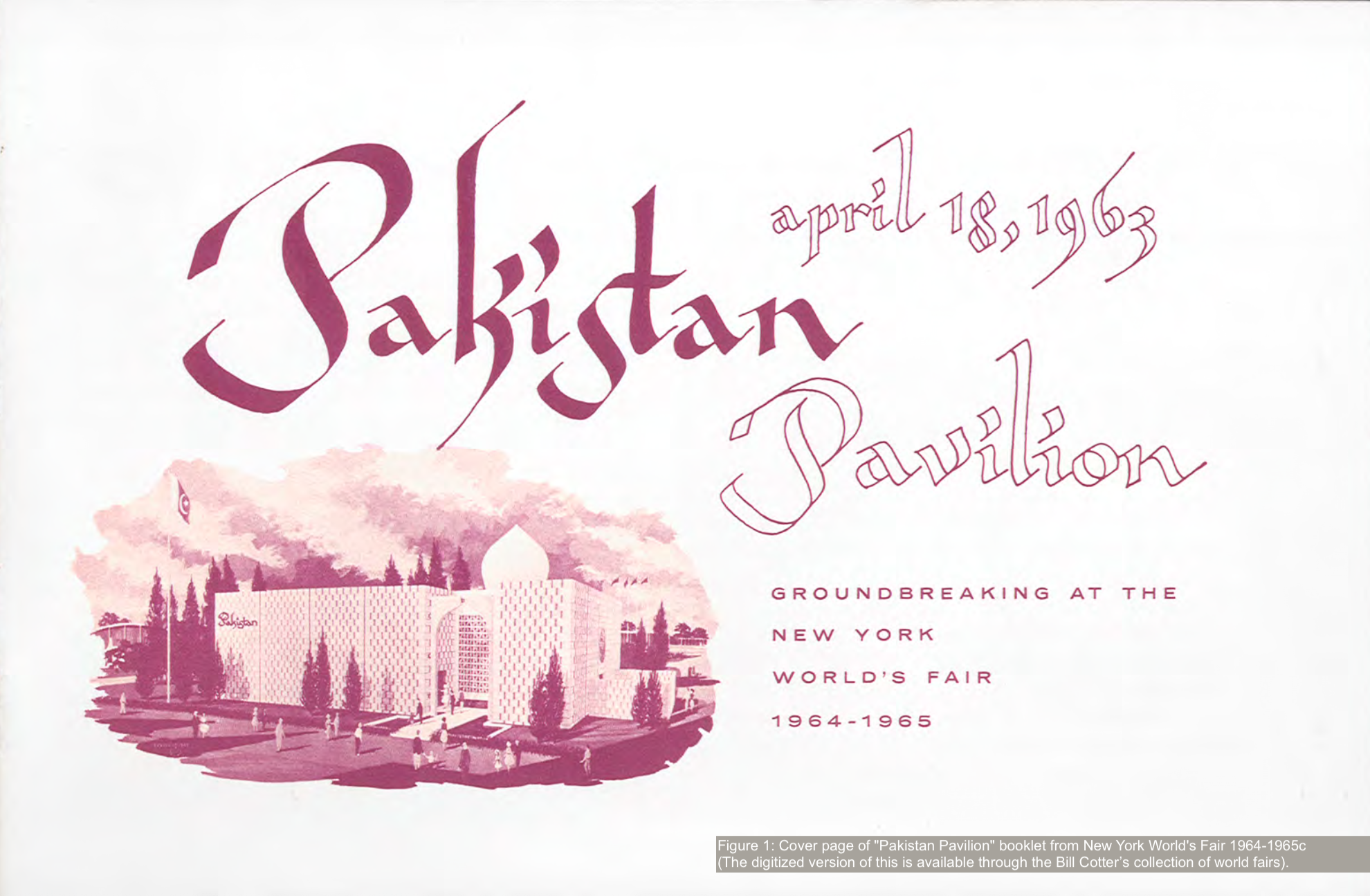
This image is the front page of a booklet for the Pakistan Pavilion, published by the New York World’s Fair 1964-1965 Corporation. April 1963, the date on the booklet of the Pakistan Pavilion, is less than 20 years after the independent nation-state of the Islamic Republic of Pakistan was established on the modern world map. The category of the nation-state is tied closely to this project of modernity and freedom; both of which were largely derived from universal (read Western) understanding/s of what this looks like. Consequently, the fundamentally colonial organizational sensibility of the spectacle continues to run through world fairs and museums of the nation-state akin to the world fairs that came before.
The world fair script is fascinating, especially in the context of the twentieth century decolonization and the emergence of nation-states. The nation-state itself was a ‘modern’ entity, a creation of the West, and therefore tied to its existence were specific representational tropes that were embedded in the language of the coloniser.
One such trope was that of the spectacle. During the British Raj in the Indian sub-continent, the spectacle took on a key role in the commodification of a people and their culture(s) within the larger project of establishing their otherness. The idea of a nation/people/culture consumed at a glance, or what Timothy Mitchell calls “the world itself being ordered up as an endless exhibition[i]”, was rooted in an essentialism that haunts nationalism/s to this day. An obvious and ubiquitous result of this was the continuation of this order through “World Fairs”— exhibitions which were colonially marked spaces displaying colonial ‘wealth’. A quintessential example of this was the Crystal Palace Exhibition of 1861 in London, which displayed the British empires ‘wealth’ from carpets, perfumes, and spices, to weapons and heavy machinery. It is within these world fairs that the idea of a nation/people/culture was commodified and reduced to be consumed as a spectacle—a finite set of visual metaphors and cues that represent a monolithic essence of a people.
Twentieth century decolonization and the establishment of ‘new’ nationalism/s was also visually embedded within these finite structures of representation. In the moment of a new nationalism, the state (and the people) now faced the challenge of depicting their culture and their history representationally. The spectacle here becomes a tool for the larger nation-building project that relies on the existence (and active construction) of a monolith ‘essence’ of a nation that legitimizes its claims of sovereignty and independence (from colonial rule).
This booklet of the Pakistan Pavilion states: “the three main themes of the exhibit areas within this pavilion will emphasize Pakistan’s Historic Past, Progressive Present, and Promising Future.”
Looking at the architecture of the Pakistan pavilion building at the New York Fair 1963, the dome stands out and is later referenced to be a characteristic of a Pakistani architectural aesthetic. The booklet defines the architecture as a “…design which is a happy blend of Pakistani architecture set in a modern structure.” The implication here is the “Pakistani architecture” is a specifically defined field and that within this structure it comes together with a ‘modern’ structure. This further implies that for the spectacle to work, the category of “Pakistani architecture” is not just assumed to be a monolith (already defined and established) but also is situated outside modernity.
The ‘dome’ and the ‘minaret’ are the two most common architectural elements that have been excerpted (read: extracted) from their larger architectural context of the ‘Islamic’ world (the mosque, the tombstone, the shrine, a place where the divine lives/wanders/is found).
In the case of the Islamic Republic of Pakistan, the ideological foundations of the nation-state laid upon upholding its legitimacy through Islam and modernity; categories that are usually portrayed as not just exclusive of each other, but also defined in negation to one another. This dilemma of an Islamic nation-state, with its push and pull of the scientific ‘secular’ modern with/against the divine and spiritual “Islam,” is then reflected in the architecture of this building—the pavilion becomes the space where the dilemma of an Islamic Republic (former tied to the divine, the latter usually based on secular notions of selfhood and rule) is visually ‘resolved’- the category of ‘Pakistani architecture’ is not just represented here, but is actively being constructed through the spectacle of the pavilion. The pavilion as a spatial and representational category is not just reminiscent, but a consequence and continuation of the categorizing language of the coloniser. The idea that a culture can be understood within the finite bounds of a building is crucial to the integrity of the nation-state to continue being understood, to be legitimated by the world as a ‘free’ and independent nation capable of self-rule. This world begins and ends within the confines of these buildings, these pavilions, which become the visual representation of nations by showing us the “imagined” in the imagined community of the nation. The culture, the fashion shows, the food, the “5000-year history[ii]” of the nation are all reduced to artefacts that are supposed to visualize the authentic (and the only) Pakistan.
[i] Mitchell, Timothy. “Orientalism and the Exhibitionary Order.” In Grasping the World, 442-460. Routledge, 2019.
[ii] Pakistan Pavilion booklet, page 3.